

Most cyber incidents don’t begin with obvious warning signs or dramatic system failures. They begin with something that could belong in a normal workday. A quick text about a small charge. A notification that a document was shared. An email that appears to come from a trusted contact asking for a simple update.
Today’s scams are designed to blend in, not stand out. They rely on timing, context and the assumption that if something looks routine, it’s probably safe. As you read through these examples, consider one honest question: Would everyone on your team recognize the risk before reacting?
The toll (or parking fee) text
A text arrives: “You have an unpaid toll balance of $6.99. Pay within 12 hours.”
It names a real toll system, the amount feels harmless, and clicking the link feels efficient. The problem is that the link leads to a convincing payment page built to capture card details or personal information.
Helpful Guardrail: Legitimate toll agencies don’t demand payment via text. Businesses should set the rule: No payments through links. Employees must go directly to the official site or app to pay.
‘Your file is ready’
An employee gets an email saying a document was shared through a familiar platform. The branding looks correct. The format matches other notifications they’ve received before.
They click, log in and move on. Except that login page may be harvesting credentials, giving an attacker access to your cloud environment.
Helpful Guardrail: If a file wasn’t expected, don’t click the email link. Log into the platform directly. Real files will be there. Restrict external sharing and enable login alerts for extra protection.
The Email is Written Too Well
Phishing emails aren’t sloppy anymore. They’re polished, specific and aligned with real vendors or internal roles. They sound calm and professional, often requesting payment updates or credential verification.
Because they mirror everyday communication, they prompt action before doubt surfaces.
Helpful Guardrail: Any request involving credentials, payments or sensitive data gets verified through a second channel. Hover over the sender’s addresses. Treat urgency itself as a warning sign.
The risk isn’t careless employees. It’s systems that assume everyone will always slow down under pressure.
If a single rushed click could interrupt your operations, the answer isn’t better instincts. It’s a stronger framework that helps your team make the right call every time.

Sometimes, it takes a series of quiet moments to relearn how to be bold and brash and take up space.
That’s how it happened for Jesse Israel, founder of The Big Quiet movement and keynote speaker at Gartner’s IAM summit last December.
He shared how, at 14, he was the unapologetic ringleader of his class, but threats of expulsion and external pressure forced him to make himself smaller. By college, Israel was terrified of public speaking and commanding a room as he once did.
Israel knew he wasn’t living as his full self, noting, “Maybe some of you can relate to this feeling of knowing that you’ve got more power inside of you, more potential to live up to.”
“Every person has an enormous well of power and potential,” Israel said.
“We all have unique gifts, abilities and strengths we are meant to be putting into our work, our families and our communities. But what I’ve seen from working with thousands of leaders is that most of us [have access to] a tiny fraction of what’s available inside, which limits our impact on the world outside.”
“The leaders, teams and organizations that were thriving were not making more noise,” Israel noted. “They had learned to effectively be quiet.”
“What blocks us from being able to access what’s within and live up to our potential is noise,” Israel said. He identified three types of noise: in the world, in our heads and in our bodies.
Israel developed a three-step process to quiet the noise.
Creating moments of quiet amid the chaos gives you an advantage. “Getting quiet when everybody else was loud gave me an edge,” Israel said. “When you practice making space, you gain the advantage that few people have,” Israel added.
Israel said reconnecting with others helped him rediscover himself. “As human beings, when the noise in our heads gets louder and we start overthinking, our tendency is to push away [from others] and isolate ourselves, keeping us from the thing we actually need and want most — people. When you notice yourself isolated, the act of courage is to take a step towards connection.”
“If you really want to cut through the noise in your life and expand what’s possible, you must assign meaning to what you do. It’s got to be about something greater than yourself,” Israel said.
For Israel, reclaiming his strengths meant embracing the qualities that once got him into trouble.
“What I’ve seen consistently is that when leaders, organizations and teams take the time to get clear about what their own genius is, on an individual basis, and then map out responsibilities based on the genius of those individuals, they become unstoppable,” Israel said.
“Oftentimes, stepping into the ‘Zone of Genius’ gets uncomfortable. As a result, we oftentimes shy away. But on the other side of fear and discomfort is our full potential. These small acts of courage are required for us to become the person we’re meant to be,” Israel said.
“You don’t have to change who you are to become more powerful. You simply have to claim who you’ve always been.”
Remember blowing into Nintendo cartridges to make them work? Once upon a time, that was our version of IT support.
Cartridge wouldn’t load? Blow on it. Still wouldn’t load? Blow harder.
If that failed, you smacked the console and hoped for the best.
We thought we were pretty good at technology.
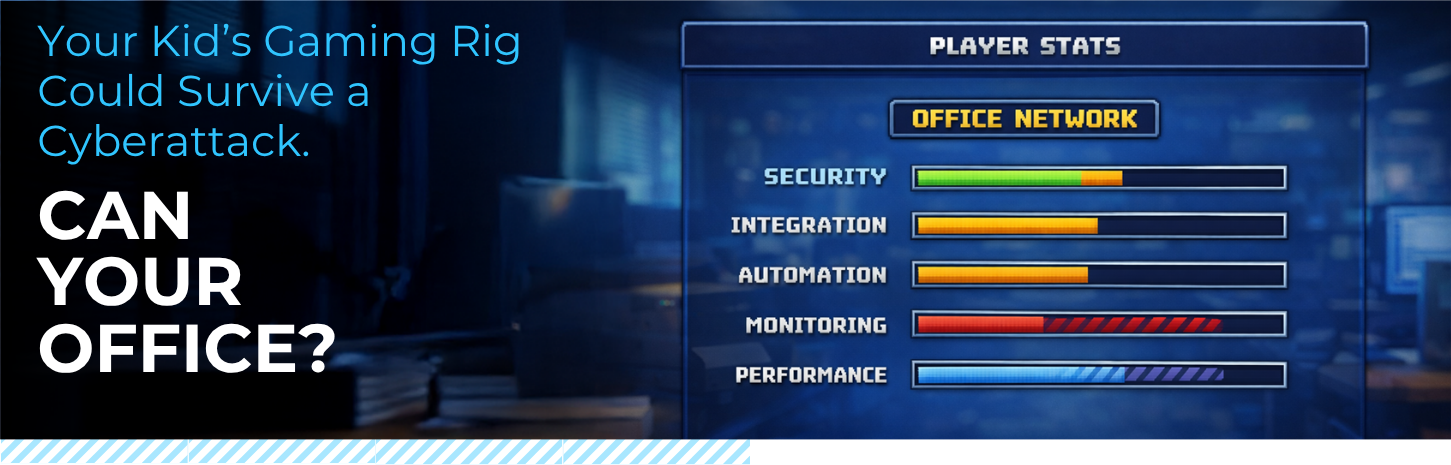
But your kid has never had to fix anything by hitting it. Their setup is a finely tuned machine: solid-state drive, 32 gigs of RAM, a processor powerful enough to render a short film, mesh Wi-Fi with no dead zones, real-time performance monitoring and multi-factor authentication on every account.
It’s optimized, tuned and maintained.
Now think about your office. There’s a workstation from 2019 that takes four minutes to boot, a printer that jams every Tuesday, shared folders named “New New Final FINAL” and software that doesn’t talk to each other. Then there’s the Wi-Fi that mysteriously dies in the conference room and the laptop with a “Restart to update” notification that’s been dismissed every morning for three weeks.
Gamers optimize. Businesses tolerate.
That gap is more expensive than most people realize.
It’s not about budget. A solid gaming PC costs about the same as a business workstation. Business internet is often faster than residential. The tools to monitor and secure a network aren’t out of reach.
The difference is attention.
Gamers update everything immediately: operating systems, drivers, firmware, patches. Outdated software means lag, and lag means losing. Meanwhile, every postponed update on your office laptops represents a known vulnerability with a fix that hasn’t been installed.
Gamers back up their progress religiously. Lose a 200-hour save once and you never forget. Many businesses, however, don’t regularly verify that backups are running properly. When a gamer loses data, it’s frustration. When a business loses data, it’s client records, financial history and possibly the ability to operate.
Gamers also monitor performance in real time. CPU temperature. Network speed. System load. They notice a small dip and investigate before it turns into a crash. Most businesses discover issues when someone says, “The internet’s slow today.” That’s not monitoring. That’s reacting.
Your kid would never run their setup that way. And their setup isn’t responsible for payroll.

No one designs a messy office network on purpose.
Business technology grows gradually. A tool gets added to solve a problem. Another platform comes in for accounting. Then CRM. Then file sharing. Then payroll. Then security layered on top.
Each decision makes sense in the moment. Over time, though, technology stops being designed and starts being accumulated. Accumulation creates friction.
Gaming rigs are built intentionally for performance. Business systems often evolve for convenience. One is strategic. The other is incremental. And incremental systems eventually become expensive systems.
Back when we were blowing on cartridges, we didn’t know better. Today, the tools and knowledge exist. The question isn’t whether improvement is possible. It’s whether anyone is actively paying attention.
The biggest cost rarely shows up as a dramatic outage. It appears in small, daily inefficiencies everyone has learned to accept.
It’s the five minutes waiting for a slow login. Searching for a misplaced file. Re-entering data into systems that don’t sync. Restarting the same machine twice a week. Creating workarounds because “that’s just how it works here.”
Individually, those interruptions feel minor, but that five-minute glitch often costs far more than five minutes. It can take over 20 minutes to fully regain focus after being disrupted. Multiply that across your team, week after week. What feels normal becomes expensive.
In gaming, lag is unacceptable. In business, lag becomes routine. And routine inefficiency quietly drains productivity.
When asked about their technology, most business owners say, “It works fine.” But working and working efficiently aren’t the same thing.
Ask yourself the following: Are your tools integrated or simply coexisting? Are your systems streamlined or stacked on top of one another? Are your processes supported by technology or constantly working around it? Is anyone watching your network proactively, before something fails?
Hardware will always evolve. What drives real productivity today is integration, automation, security and thoughtful system design.
None of that improves by accident.
“16 Years.
Sixteen years ago, we set out to help businesses stop worrying about technology so they could focus on their work. That hasn’t changed.
You’ve trusted us to pick up the phone, tell you the truth, and treat your business like it matters, because it does. Thank you for being the reason these 16 years mattered.”
– Cary Showalter, CEO

Oct 12th – Columbus Day – Don’t forget we’re ALWAYS available if you need us. Contact Support
Oct 14 – 36th Annual Mabel H. Bexley Gift of Peace Lunch – The Spring
Oct 18th – CASA Citrus Step Up For Survivors Walk – Come say Hi to the team! Or even JOIN the fun and a great cause!
October 21st – ShowTech Webinar – ShowTech Developed AI Apps In Action
Oct 31st – Halloween! Have a spooky & safe weekend!

Dax focuses on ensuring every client feels valued and supported. With a background in client relations, leadership, and communications, he oversees onboarding, relationship management, and customer satisfaction. His mission is simple: to make sure clients never feel like just a number.
With more than 20 years of IT experience, Cary founded ShowTech Solutions to bring a more personal and responsive approach to managed services. He’s passionate about helping local businesses run securely and efficiently through technology that works, without all the jargon. Cary’s commitment to excellence and community is at the heart of everything ShowTech does.

Experienced technology executive with 27+ years leading and scaling managed service providers across diverse industries. Charles is widely respected for his strategic consultancy expertise and a consistent record of delivering impactful results for technology companies.
He has earned multiple industry accolades for leadership, team development, and customer excellence—underscoring his commitment to building collaborative, high-performing environments. Charles approaches every engagement with integrity, cultivating strong partnerships with both clients and internal teams.
In addition to his leadership roles, Charles serves as a trusted virtual CIO to clients, aligning technology strategy with long-term business objectives. He provides executive-level guidance across IT budgeting, risk management, digital transformation, and vendor optimization—ensuring that every decision delivers measurable business value.